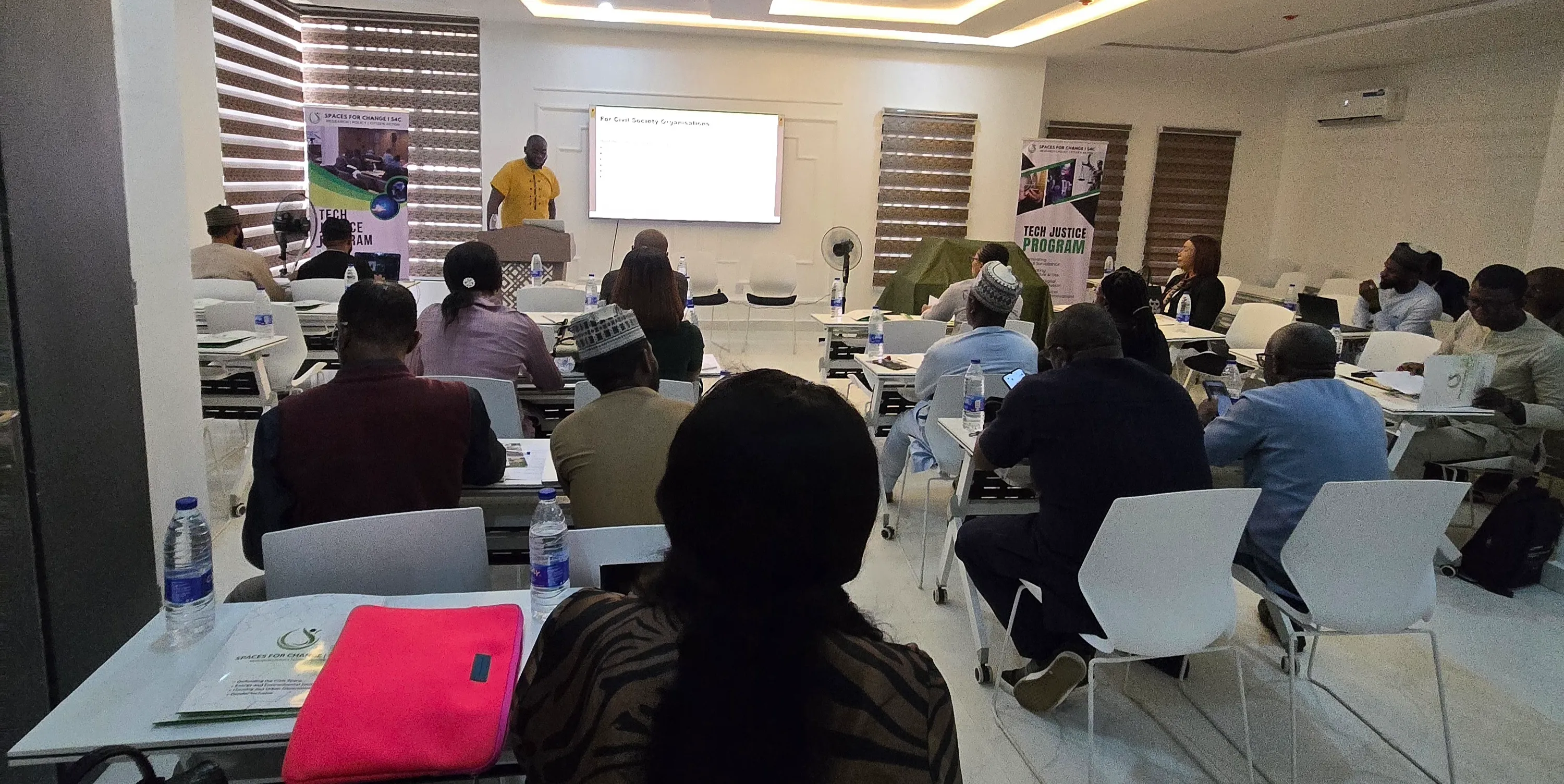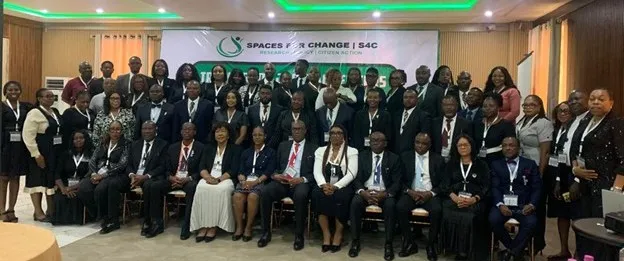
Fifty (50) judicial officers and state prosecutors from Imo and Abia States participated in Spaces for Change’s |S4C’s high-level training, dubbed, Civic Space Protection in Times of Crisis, held on February 23 – 24 in Owerri, Imo State. The training brought together judicial officers and public prosecutors involved in the adjudication of complex trials in agitated socio-political environments like the South-eastern region of Nigeria, to deepen their understanding of the security-rights balance and civic space protection in times of crisis.
The high-level training was prompted by the findings of S4C’s latest report— CIVIC SPACE IN WEST AFRICA: TRENDS, THREATS, AND FUTURES 2nd EDITION— which presented alarming evidence of the rise of judicially-enabled repression of civic freedoms in Nigeria and across West Africa. On the Closing Spaces Database—www.closingspaces.org—incidents of judicially-enabled repression surged from 9 cases (2017–2022) to 70 cases (2022–2024), a near-700% increase in a fraction of the time. Courts across West Africa have enabled repression by upholding vague, politically-motivated criminal charges such as treason, terrorism, cybercrime, and murder. These charges are filed not to secure convictions, but to intimidate, exhaust, and delegitimize civic actors. The process itself becomes the punishment, draining resources, damaging reputations, and isolating targets from support networks. Another method is through court-sanctioned prolonged pre-trial detention. Courts issue remand orders that serve as a pretext of legality for unlawful detention. Bail is denied on vague security grounds while hearings are perpetually adjourned. Along these lines, the training was designed to equip participants with the legal skills to identify, counter, and prevent abusive legal actions aimed at either silencing public interest/strategic litigation or weaponizing security laws to clamp down on civic freedoms.
The South East region of Nigeria is no stranger to insecurity. Decades of political and economic marginalization provided a springboard for agitations by separatist groups in the region such as the Eastern Security Network (ESN) and the Indigenous Peoples of Biafra (IPOB). Countermeasures developed in response to these agitations prioritized securitized and other kinetic measures, including the designation of secessionist groups as terrorist organizations. Likewise, secessionist groups have enforced acts of civil disobedience such as the weekly Monday sit-at-home exercises, suppressing the freedom of movement, assembly and association rights while crippling economic and commercial activities in the region. The activities of both state and non-state actors have contributed to significant civic space contractions and restriction on civic freedoms in the region.
Operating in this tensed background puts heavy pressure on the judiciary who are saddled with the responsibility of defining and illuminating the blurred lines between public security, lawful agitations, freedom of expression and human rights. As noted during the training, “the judiciary is the guardian of constitutionalism… and when they fail to protect human rights, it aggravates the sense of marginalization and factors that fuel insecurity”. The training highlighted the different ways of identifying SLAPPs and the legal frameworks that judicial officers can invoke to counter them. The training also featured deep dives into civil and criminal procedures in complex trials as well as the roles ex parte applications and orders, witness protection programs, judicial precedents and judicial activism play in either expanding or narrowing the civic space. The civic space is also protected when judicial officers incorporate principles of legality, proportionality, necessity and accountability in such trials.
Complex trials invite a lot of pressure from both the executive, political and other powerful actors. Who are these powerful actors and how can judges successfully navigate such pressures especially those from from high places? Judicial pressure manifests through undue executive interference in judicial processes, trumped up criminal charges, enticement and rewards, judge’s house or office raids, targeted surveillance and outright intimidation when judges take decisions that annoy “powerful interests” in their jurisdictions. Information-sharing and story-telling sessions on judicial pressure evoked powerful emotions among participants, highlighting the risks, threats and heavy weights that judicial officers often bear in the course of delivering justice. Pressures often come from outside and within the judicial system, including superiors, colleagues, and close associates.
Building solidarity and support systems can serve as a first line of defence. Also, it may be worthwhile to explore partnerships with trusted allies in civil society who can facilitate social protection mechanisms for ensuring their personal safety and protection. As the training wound down, participants commended Spaces for Change for the timely intervention. The 2-day training was organized with support from The Fund for Global Human Rights.