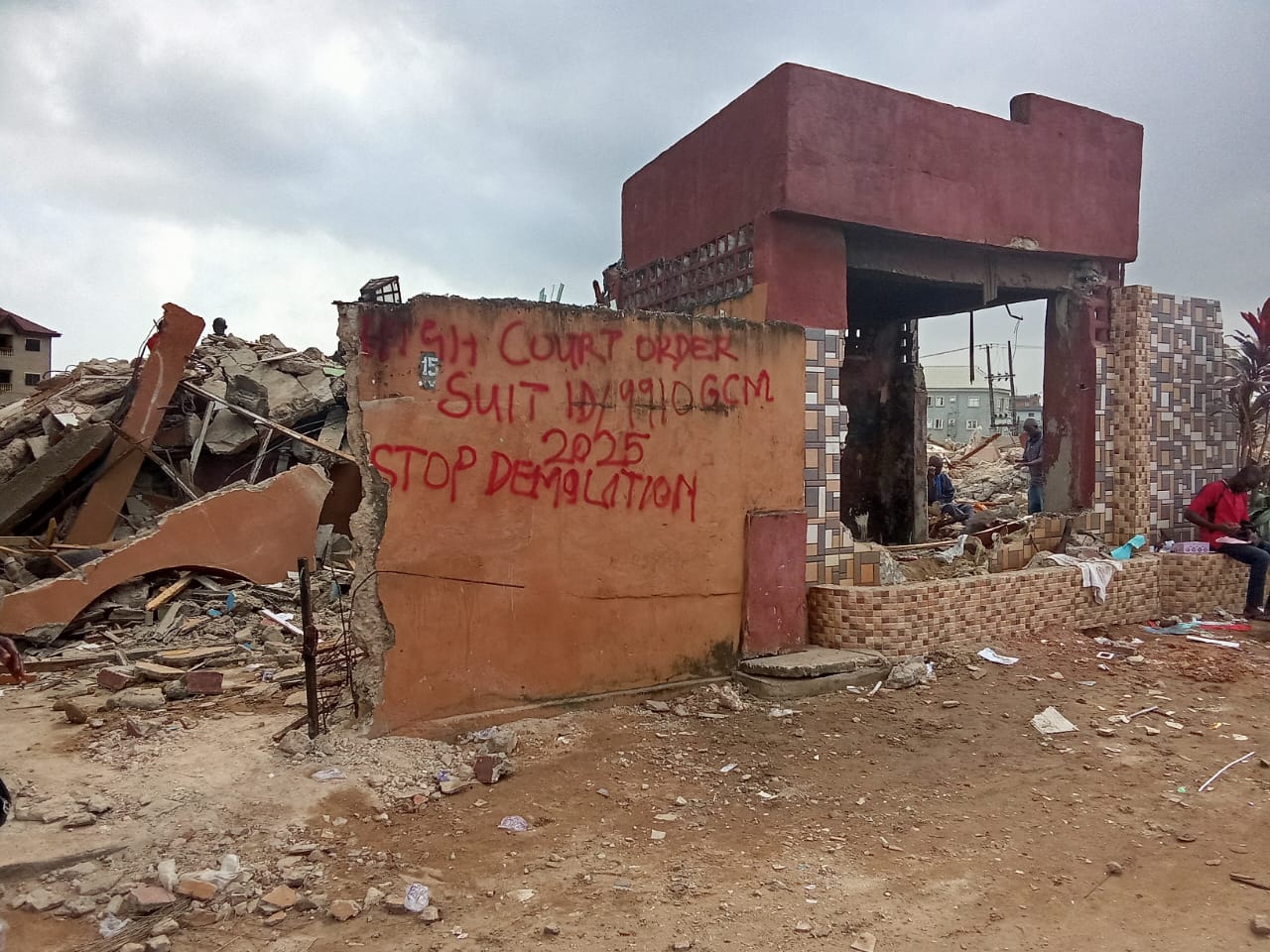
 Spaces for Change |S4C has documented another case of forced eviction in Lagos State following the demolition of over 100 homes in Oworonshoki on Sunday, October 26, 2025. The Lagos State Government Task Force, comprising officials from the Ministry of Physical Planning and Urban Development and the Lagos State Building Control Agency (LASBCA), carried out the demolition late at night, accompanied by heavily armed security operatives.
S4C’s housing monitoring team established that the demolition began around 10 p.m. and continued into the early hours of the following morning. Residents of Ojileru, Ososa Extension, and Toluwalase Extension within the Itesiwaju Ajumoni Community Development Area recounted how bulldozers pulled down their homes while they were still inside, leaving them with little or no time to gather their belongings. Tear gas was reportedly deployed, and several residents sustained injuries while attempting to flee the scene. Many of the affected households have lived in the area for over two decades, with some structures dating back to 1986, before the introduction of the current building permit regime.
In March 2025, officials from LABSCA’s Ogudu office served a seven-day notice directing property owners to present their building approvals for verification. The residents complied, but when they visited the agency’s office, they were informed that the notice did not originate from that branch. They were then referred to the Oba of Oworonshoki, who assured them that there was no cause for concern and encouraged them to improve the aesthetics of their surroundings. Many borrowed money to renovate their homes in good faith. Despite these efforts, subsequent demolition notices were issued, and in the months that followed, parts of the community were targeted. It took the intervention of a federal legislator to halt an earlier phase of the demolition. Residents later sought legal redress through human rights lawyer Femi Falana (SAN) who filed a lawsuit at the Lagos State High Court on their behalf. On October 23, 2025, three days before the latest demolition, the court granted an interim injunction restraining the Lagos State Government, the Attorney General, the Commissioner for Physical Planning and Urban Development, and LABSCA from further demolishing structures in the community. The order was duly served and acknowledged, however, in blatant disregard of the court’s directive, the demolition proceeded.
The method employed in executing the demolition not only raises serious ethical concerns but also violates both national and international legal standards protecting the right to adequate housing and protection from forced evictions. Conducting a demolition exercise at night, accompanied by heavily armed policemen and the use of tear gas, amounts to cruel, inhuman, and degrading treatment prohibited under Section 34 of the 1999 Constitution of the Federal Republic of Nigeria (as amended). The use of violence and intimidation against residents, many of whom were women and children, also contravenes the procedural safeguards outlined under international human rights instruments to which Nigeria is a party too.
The United Nations Basic Principles and Guidelines on Development-Based Evictions and Displacement (2007) require that evictions must be carried out lawfully, with adequate notice, genuine consultation, and provision of alternative accommodation. Similarly, the African Charter on Human and Peoples’ Rights, which has been domesticated into Nigerian law, guarantees the right to property and protection from arbitrary displacement. The Oworonshoki demolition disregarded these principles entirely. It not only breached a subsisting court injunction but also failed to meet the minimum procedural and humanitarian standards required during eviction processes.
Beyond the disregard for due process and the excessive use of force, the question of compensation remains unresolved. Contrary to narratives circulating on social media, affected residents have not received any form of compensation. During S4C’s field visit, community members disclosed that a form was circulated by a local development committee proposing a token payment of three hundred thousand naira for structures made of plank and five hundred thousand naira for a permanent structure, to be distributed at the traditional ruler’s palace. The residents unanimously rejected the offer, describing it as non-transparent and grossly disconnected from the magnitude of their losses. Many lamented that their homes were built decades ago, when a bag of cement cost as little as ten naira, and that rebuilding now, with the skyrocketing construction costs, is far beyond their means. This raises deeper questions about how compensation is determined, who decides its adequacy, and why a traditional ruler, who is not a state actor, appears to be the conduit for a government-led process.
The demolition of Oworonshoki underscores a recurring crisis of governance in Lagos State’s urban planning and development practices, one where vulnerable communities bear the brunt of weak institutional coordination, opaque administrative processes, and disregard for court directives. The demolition, carried out despite an active injunction, constitutes a breach of the right to property guaranteed under Section 43 of the 1999 Constitution (as amended) and reflects a wider erosion of public trust in adjudicatory systems meant to protect citizens.