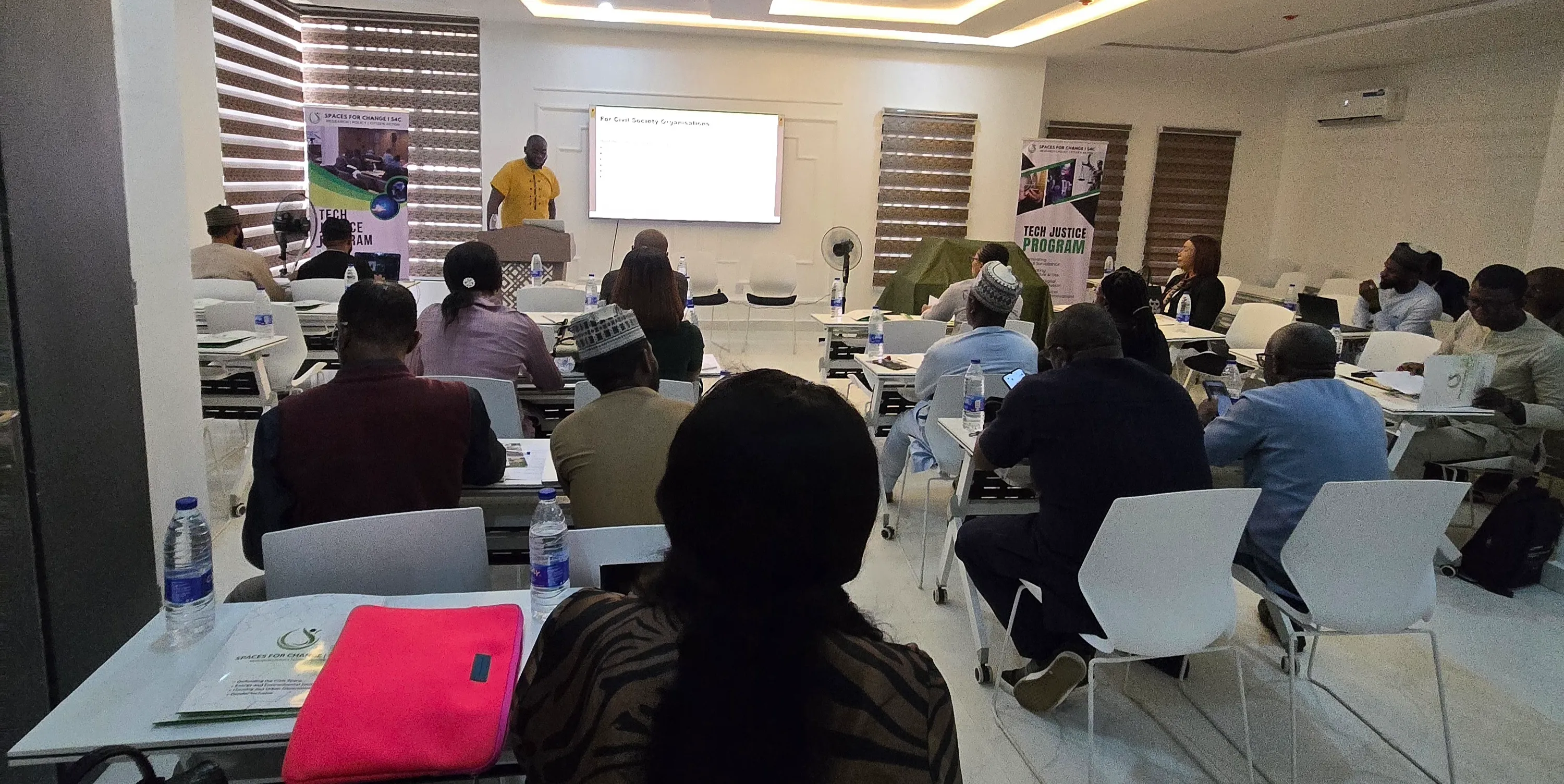
 The January 29 National Conference on Digital Rights 2026 brought together a diverse group of civic actors, media professionals, academics, students and representatives of government agencies to promote the integration of human rights-centric principles into the governance of artificial intelligence, ensuring accountability, transparency, and fairness. Funded by the European Union and implemented in partnership with Avocats Sans Frontières France, Spaces for Change | S4C, and the Centre for Information Technology and Development (CITAD), the conference, “Advancing Digital Rights: Fortifying Governance, Expanding Access and Safeguarding Civic Freedoms in a Digital Society, provided a multistakeholder platform for deliberating on strategies for embedding digital rights into all facts of technology, design, governance and deployment in Nigeria.
During the panel, titled, “Human Rights-Centered AI Governance in Nigeria: Roles, Responsibilities, and Accountability,” S4C and other panelists comprising representatives of government agencies, tech law firms, civil society and the academia examined the legal concepts and human rights-centered principles undergirding AI governance. S4C elucidated the meaning of “human rights by design”, with emphasis laid on embedding human rights principles into the design, development, deployment, and the entire lifecycle of AI technologies. The “human rights by design” framework emphasizes the proactive integration of key human rights norms, including privacy, data protection, equality, transparency, non-discrimination, and accountability. It was emphasized that human rights considerations should not be treated as an afterthought after harm has occurred, but rather as a foundational principle guiding AI system development. The discussion highlighted the need to shift from reactive responses to proactive governance models.
Discussions also focused on the immediate human rights risks associated with AI systems. It was noted that AI systems rely heavily on large datasets, and the extraction and processing of such data can lead to profiling practices that may exclude or discriminate against certain groups. Concerns were raised about the use of AI-driven algorithms to monitor online conversations and determine content visibility. Such systems, if not properly regulated, may result in the suppression or criminalization of legitimate civic discussions and may restrict freedom of expression.
The panel further explored groups that may be disproportionately exposed to AI-related harms. Young people were identified as a key group, particularly due to increasing reliance on AI tools for academic work and decision-making processes. Overreliance may affect critical thinking, independent reasoning, and long-term cognitive development. Women were also identified as a high-risk group, particularly in the context of technology-facilitated gender-based violence, including online harassment, non-consensual image sharing, and AI-generated harmful content.
There were also discussions on available legal remedies within Nigeria’s current legal framework in cases where AI systems contribute to human rights violations. It was noted that existing legal and regulatory systems have not fully kept pace with rapidly evolving technologies. There was consensus on the urgent need to strengthen legal frameworks to address emerging risks associated with AI and other advanced digital technologies.
In discussing national AI governance priorities, emphasis was placed on the importance of infrastructure development, including secure data storage facilities that support AI innovation. However, conversations went beyond infrastructure to highlight the need for digital sovereignty. It was noted that while Nigeria currently focuses on expanding digital access, more needs to be done to increase national control over digital infrastructure, data governance, and technological ecosystems. The discussion stressed that digital sovereignty plays a critical role in strengthening regulatory effectiveness and national technological competitiveness. It was further emphasized that for Africa to become a significant global player in AI, there must be strategic investment, long-term policy planning, and stronger participation in global technology governance conversations.
The session concluded with a call for the government, in its role as regulator, to balance the need to attract AI investment with the responsibility to protect citizens’ rights. Emphasis was placed on strengthening institutional capacity to ensure the protection of Nigerians’ personal data. The government was encouraged to adopt a more stakeholder-inclusive approach involving civil society organizations, non-governmental organizations, and citizens in policy development and implementation. The discussion also highlighted the importance of accessible complaint and redress mechanisms for citizens affected by technology-related rights violations, as well as stronger inter-agency collaboration to ensure coordinated and effective AI governance.