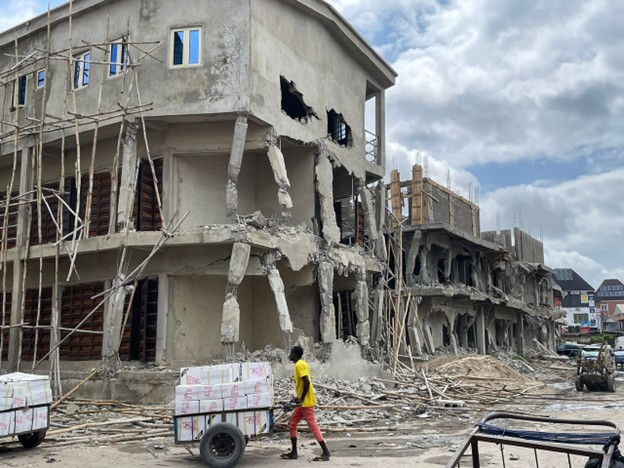
Spaces for Change | S4C visited the Lagos International Trade Fair Complex on September 25, 2025, where the Lagos State Government ordered the selective demolition of plazas, malls, shops, and business premises. The demolition operation was led by the Lagos State Building Control Agency, the Lagos State Physical Planning Permit Authority, and the Lagos State Urban Renewal Agency, all backed by armed security operatives and thugs acting on government directives.
S4C met a horde of angry and sorrowful traders lamenting the demolitions, recounting their losses running into billions of Naira. S4C gathered that the management and administration of the Trade Fir Complex statutorily falls under the Lagos International Trade Fair Complex Management Board Act of 1993. This Act empowers the Board, a federal body, to regulate new structures and grant leases to investors and business owners. Several victims erected their structures with approvals issued by the Board through the Federal Ministry of Works and Housing. Yet, the Lagos State Government insists otherwise, arguing that it is the rightful authority to issue approvals. Hence, the approvals issued by the federal authority is null and void.
The demolition was justified under the banner of clearing “illegal developments, structures without statutory approvals, defective structures, and structures built on road setback and drainage.” According to the Commissioner for Physical Planning and Urban Development, Oluyinka Olumide, the state acted under the authority of a 2003 Supreme Court judgment and the Lagos State Urban and Regional Planning and Development Law 2019 (as amended). He argued that being on federal land does not exempt developers from obtaining state planning permits or compliance with Lagos’ regulations.
This clash of jurisdictions raises fundamental questions: Which approvals hold legal weight—those granted by the federal Board or those issued by the state? And if the law is unsettled, why should traders bear the cost of governmental conflict, losing both their investments and livelihoods? Beyond the clash of jurisdictions, the demolition exercise raises pressing concerns about due process. Under the Lagos State Urban and Regional Planning and Development Law of 2019 (as amended), any enforcement action, including demolition, is required to follow specific procedures: issuance of statutory notices, opportunities for affected persons to respond, and proper consultation with stakeholders.
However, testimonies from several eye witnesses reveal a stark detour from these legal safeguards. The accounts of several victims, including the Executive Director/CEO of the Lagos International Trade Fair Complex Management Board and its management team, the president of the traders’ association, consistently pointed to one fact: no prior notice or consultation was given before bulldozers rolled in. Neither the Board, which holds statutory authority over the complex, nor the traders who leased and invested in the structures, were officially informed of the planned exercise. The buildings were marked and demolished on the same day. Worse still, those who attempted to protest were physically assaulted by security operatives and non-state actors mobilized by the state. For many victims, the combination of economic loss, physical intimidation, and abrupt displacement has produced deep despair, amplifying the sense of lawlessness surrounding the exercise.
The violent nature of the demolitions raises several due process concerns. If the Lagos International Trade Fair Complex is under the statutory authority of the federal Management Board, why were neither the Board nor its tenants consulted? If the Lagos State Government insists that its mandate under the 2019 Urban and Regional Planning and Development Law extends to the Trade Fair Complex, why were the safeguards of that same law ignored?
Against this backdrop, S4C issued a press release on September 26, criticizing the demolitions. The Trade Fair demolition exposes deeper flaws in urban governance; contradictions in the rule of law, disregard for due process, and a governance style that reduces citizens to expendable casualties. Development can and should be pursued without sacrificing legality and human dignity. Reconciling federal and state mandates requires clearer institutional coordination, transparent communication, and most importantly, the active participation of those whose lives and livelihoods are directly affected. As long as contradictions are settled through bulldozers instead of the rule of law, Lagos will keep building its future on the ruins of its peoples’ dignity and investments. True renewal begins where citizens’ rights are upheld, not destroyed.