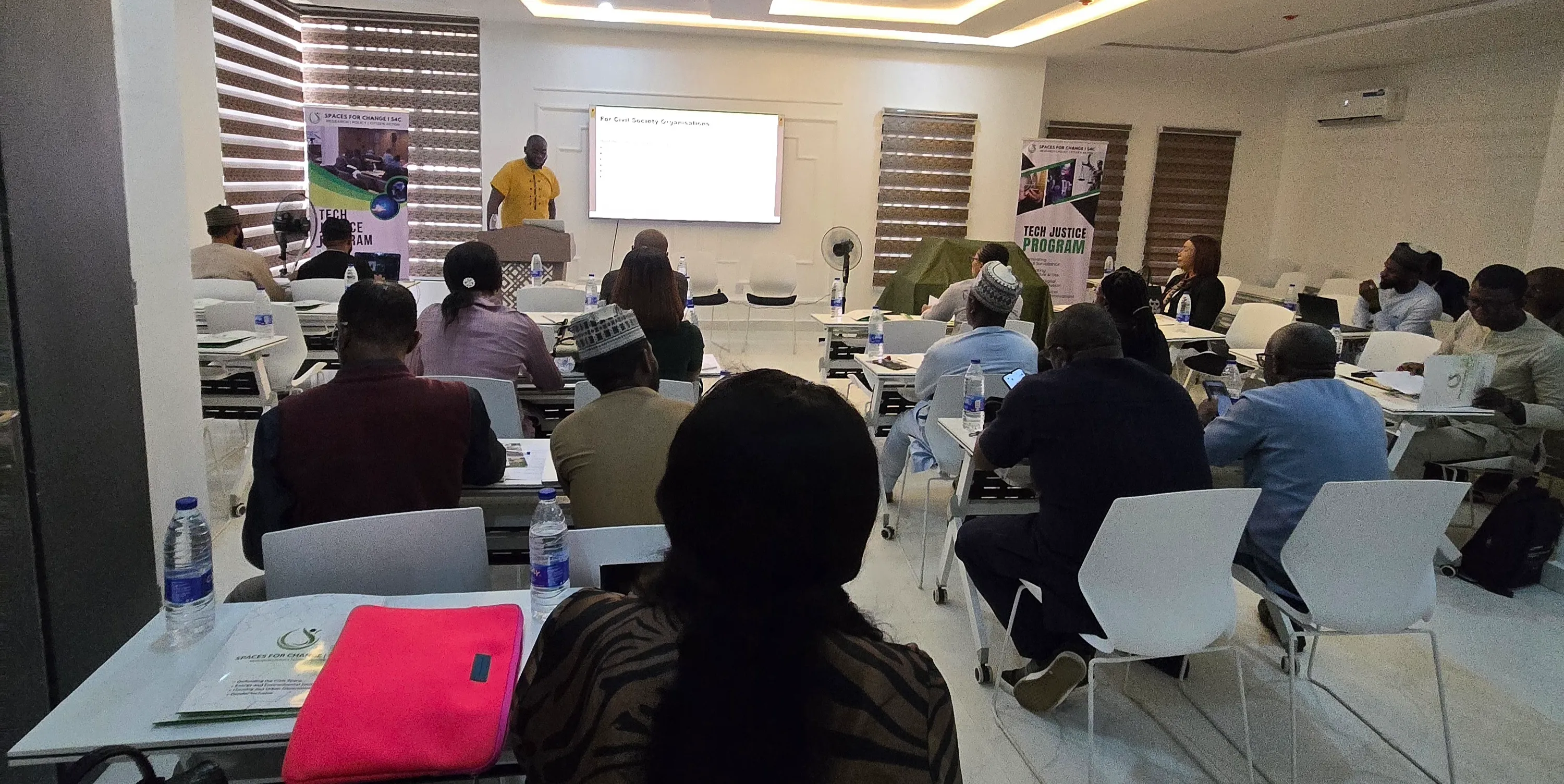
Fifty-three (53) leaders and representatives of informal communities in Lagos attended the first general assembly of the Communities Alliance against Displacement |CAD on May 20, 2026. From Bariga, Ajah, Lagos Mainland, Badagry, Snake Island, and Badia-East, CAD members converged at Spaces for Change’s | S4C’s headquarters in Lagos, Nigeria, to strategize on how to ensure that issues affecting communities and marginalised groups —such as forced evictions, land grabbing, coastal reclamation, urban renewal and participatory governance—are central to the electoral debates and political priorities ahead of Nigeria’s 2027 general elections.
What happened in 2025? What lessons were learned and what needs to be scaled up? The meeting kicked off with a collective reflection on last year’s milestones, achievements and unmet expectations. Through S4C’s pro bono legal services to communities and vulnerable groups, CAD took on five (5) civil cases and successfully defended two (2) criminal charges involving community rights advocates. For instance, Agbodemu Ishola was slammed with criminal charges for using his social media handles to decry the forceful eviction of over 4000 residents, including women and children, in Ebute Metta community, Lagos State. S4C and CAD defended him in court and secured his discharge. CAD has also filed a fundamental rights enforcement class action before the Federal High Court in Lagos, challenging the forced eviction of Ebute Metta residents.
CAD also conducted solidarity outreaches to victims of forced eviction and other communities facing eviction threats, such as the Oworonshoki in Lagos, where over 70 homes were demolished despite a restraining court order by the Lagos State High Court against it. CAD also engaged the Okun Alfa Lagos coastal communities where ocean surges are increasingly washing away homes and farmlands. In Daudu and Naka communities of Benue State, CAD extended its flagship WomenPowa free-interest loans to 120 women and young persons who have suffered conflict-induced displacements. These engagements have heightened solidarity-building between communities in distress, while strengthening their agency to seek redress.
On the policy engagement front, S4C and CAD engaged the Lagos State Tenancy and Recovery of Premises Bill 2025 at the Lagos State House of Assembly—a proposed law redefining the legal framework governing tenancy agreements, rights, responsibilities, and the processes for tenants’ eviction in the State. S4C submitted and presented a memorandum during a public hearing by the Lagos State House of Assembly. The memorandum recommended restrictions on arbitrary rental increases, regulation of the activities of agents and middlemen, introduction of rent controls and anti-discrimination measures to protect tenants from discriminatory practices by landlords.
Other activities CAD and S4C undertook in 2025 include tax literacy programs for local communities, a petition challenging commercial construction work that blocked Badia community’s drainage system and the rollout of the Monthly Eviction Tracker which tracks and analyses key forced eviction incidents across Nigeria on a monthly basis. The tool provides timely and reliable data on communities affected by forced evictions, highlights patterns of housing rights violations, and supports advocacy for the protection of the right to adequate housing.
From looking back at last year’s achievements, communities started strategising on ways of increasing public safety and vigilance in their neighbourhoods, particularly during this period of heightened insecurity in the country. This was perceived as a proactive approach toward countering forced evictions considering Lagos State’s longstanding practice of undertaking slum clearance campaigns as a pretext for crimefighting. Informal communities are often labelled as the haven for criminals—a narrative popularly used to justify forced evictions. Local vigilance programs were therefore conceived as a means of protecting their communities from criminal elements who may want to perpetrate criminal activities there, making them prime targets for demolition executed under the pretext of curbing criminality.
Community leaders also reflected on the strategies for engaging aspirants within their localities and constituencies seeking elective positions in various political parties. They itemised action points of significant concern to local communities, and constituted a committee for taking these demands forward with both political leaders and leading political parties.
The meeting concluded with the development of a detailed action plan and time table for the year. Departing the venue on a strong note of solidarity, members pledged to continue supporting for one another in times of crisis. Spaces for Change and CAD remain committed to empowering communities and promoting an equitable and inclusive urban landscape.