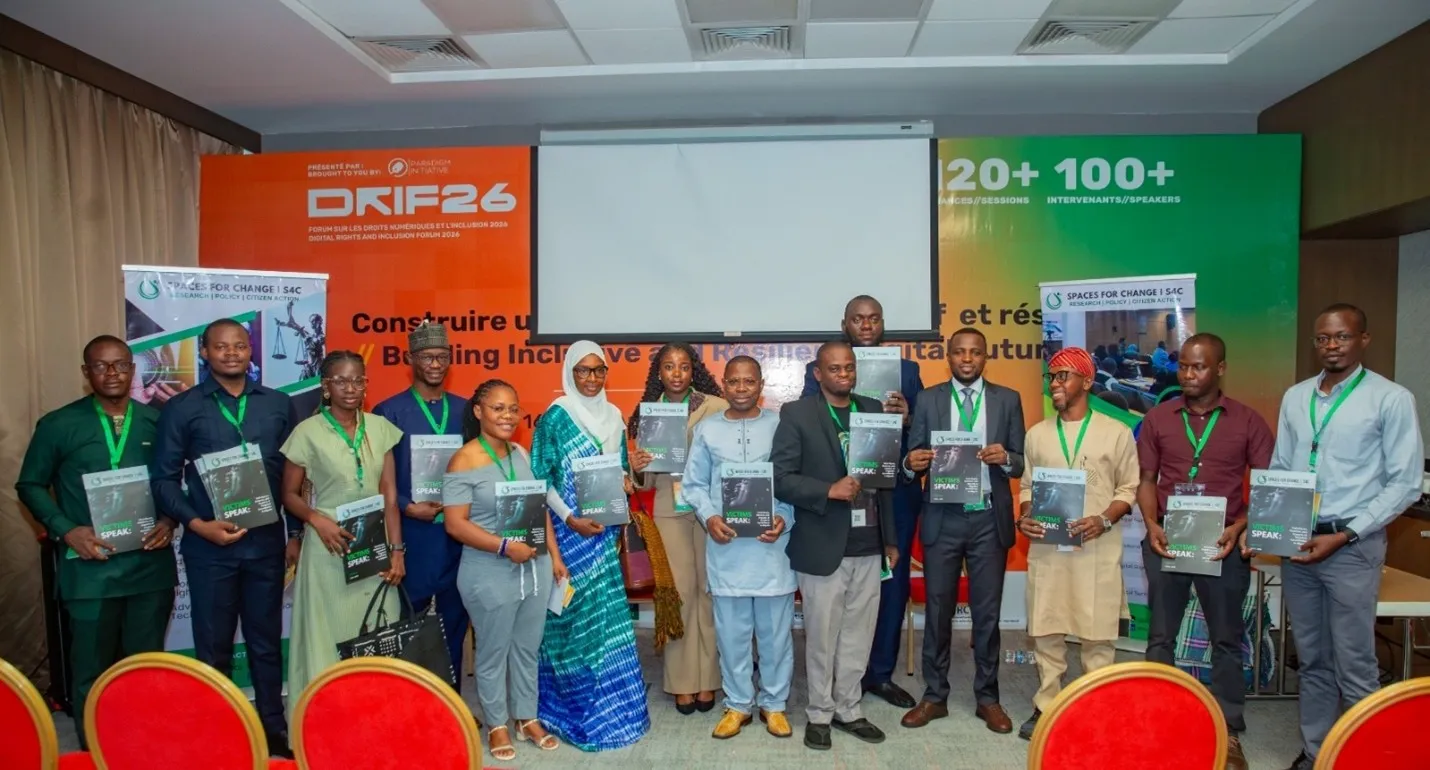
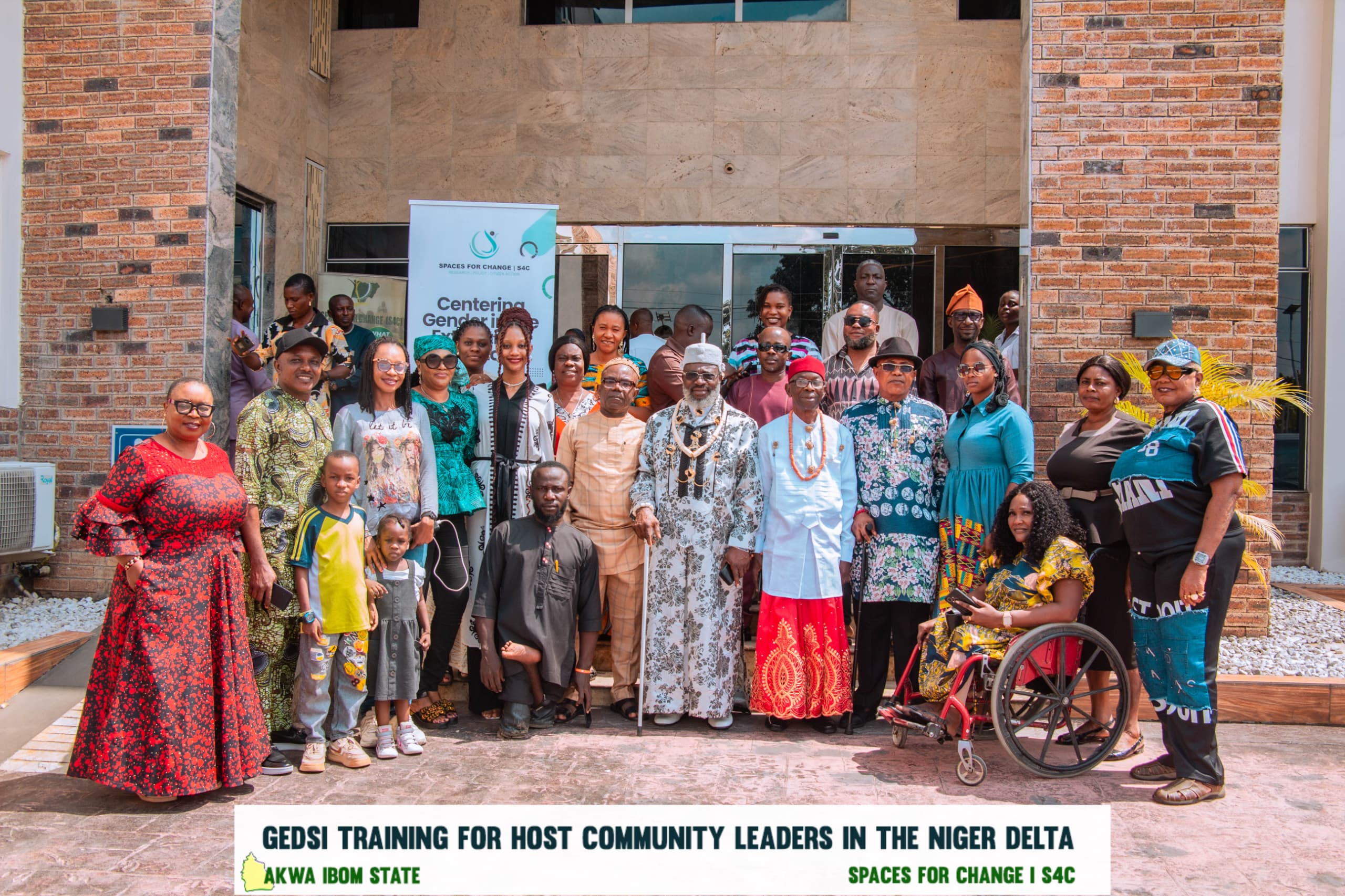
 Sixty-one leaders of extractive communities in the Niger Delta states of Delta, Bayelsa, Cross River, and Akwa Ibom participated in the 2nd edition of the training on Gender Equality, Disability, and Social Inclusion (GEDSI) held on November 14, 2025. Spaces for Change | S4C convened the training for leaders of Niger Delta host communities under its Centering Gender in Extractives Justice (CGE) Project supported by the Ford Foundation. Participants comprised members and trustees of Host Community Development Trusts (HCDT), traditional rulers, persons with disabilities, representatives of youth and women’s groups, local government actors, leaders of the media, civil society and community-based organizations. They gathered with a common purpose: to strengthen inclusive leadership, deepen GEDSI integration within community governance structures, and chart pathways towards more equitable decision-making across extractive communities in the Niger Delta.
The opening reflections reminded participants that GEDSI principles are not abstract concepts, but practical tools that determine whether communities thrive, whether people are able to contribute and lead, and whether justice becomes a lived reality rather than a deferred promise. The discussions underscored the urgency of translating these principles into concrete actions within frameworks such as the Host Community Development Trusts, where inclusive participation is central to fair and accountable resource governance.
In the first set of discussions, leaders examined how exclusion manifests in everyday community life, from inequitable benefit-sharing and environmental degradation to delayed or insufficient compensation and governance structures that silence women, youth, and persons with disabilities. They explored the Representation–Participation–Benefit-Sharing (RE–PAR–B) model as a practical guide for strengthening fairness in HCDT structures, working through how communities can ensure diverse representation on boards, create accessible decision-making spaces, and distribute natural resource benefits equitably. Participants engaged with tools such as community scorecards, learning how monthly or quarterly assessments can help track transparency, leadership performance, and community inclusion. Many committed to taking these tools home, pledging to sensitize community members on the Petroleum Industry Act (PIA), support women and youth to assume leadership roles, and address the barriers that have long hindered equitable participation.
As the dialogue progressed, the training shifted towards the emotional and psychosocial dimensions of governance. Participants reflected on the connection between gender, mental wellness, and leadership in extractive communities, acknowledging how cultural expectations, livelihood pressures, and community dynamics shape emotional well-being. They examined how exclusion, whether through sidelined voices, harmful cultural norms, or rigid expectations, can heighten stress, silence vulnerability, and fuel unhealthy coping mechanisms. These reflections opened the door to deeper conversations about the pressures faced by men who feel compelled to conceal vulnerability, women who shoulder multiple burdens without support, and persons with disabilities who navigate both physical barriers and social stigma.
Through these exchanges, leaders began to appreciate mental wellness as a critical component of community resilience. They discussed the importance of creating safe, judgment-free spaces where community members can express concerns, build support networks, and incorporate psychosocial needs into development planning. Participants emphasized that communities grow stronger when vulnerability is not punished but understood, when PWDs are prioritized rather than sidelined, and when communication is open, accessible, and humane.
Attention then turned to practical challenges of inclusive leadership. Through role-play exercises and scenario-based activities, leaders worked through situations involving equitable resource distribution, scholarship allocation, and tensions between traditional practices and modern expectations of inclusion. These hands-on exercises brought theoretical discussions to life, allowing participants to test their values against real-world dilemmas and to practice leading with fairness, balance, and empathy. Many described this moment as a turning point, an opportunity to reckon with the responsibilities of leadership in communities shaped by extraction, inequality, and competing interests.
The training also examined the legal and regulatory dimensions of GEDSI within HCDTs, including the provisions of the PIA 2021 and relevant Nigerian Upstream Petroleum Regulatory Commission (NUPRC) regulations that embed gender and social inclusion in community development structures. Participants reflected on gaps between what the law provides and what communities experience in practice, emphasizing the need for collective advocacy to ensure that HCDTs function as intended. These discussions sparked urgent conversations about representation gaps, particularly the limited inclusion of women, youth, children, and PWDs in trust governance and community decision-making. Leaders responded by outlining concrete commitments: increasing women’s presence in HCDT deliberations, reserving seats for marginalized groups, strengthening the leadership pipeline for youth and women, and organizing sensitization programs that bring legal and policy knowledge directly to the communities that need it most.
A planning exercise brought these reflections together, allowing participants to draft community-specific action plans that addressed what is missing in their governance structures, who must be included, and what partnerships and support systems are required to close existing gaps. The plans highlighted the need for continuous capacity building, awareness campaigns, and resource mobilization to embed GEDSI into the heart of community governance.
Across the training sessions, what emerged was far more than new knowledge on GEDSI tools or governance frameworks. Leaders began to see inclusion not as an add-on to community development, but as the very architecture that determines whether progress is shared or withheld. They recognized that when voices are excluded, communities fracture; but when inclusion becomes intentional, governance strengthens, trust deepens, and resilience takes root.
A shift occurred in the room: participants came to understand that transforming extractive governance begins with transforming how communities listen, decide, and lead. The conversations, reflections, and collective planning redefined inclusion as a shared responsibility, carried by every leader, every institution, and every voice that shapes the Niger Delta’s future.
A participant captured the moment this way: “Justice begins with inclusion; once every voice counts, progress becomes possible.”
That realization reverberated across the room, underscoring a truth that will outlast the training: in the Niger Delta, inclusive governance is not merely a principle; it is the pathway to dignity, equity, and lasting change.