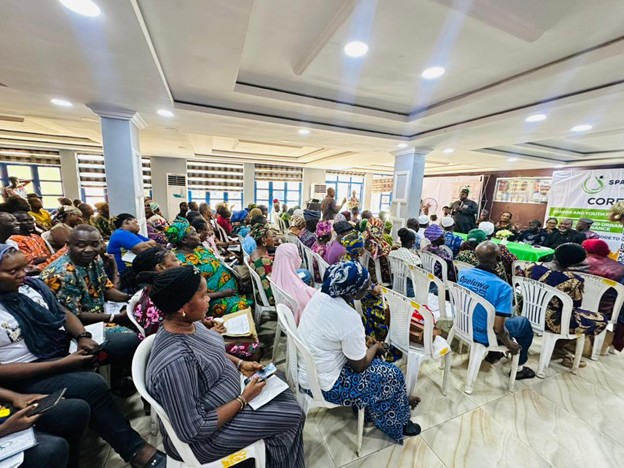
Ahead of the January kick-off date for the new tax regimes in Nigeria, Spaces for Change | S4C partnered with the Lagos State Internal Revenue Service (LIRS) and the Lagos Mainland Local Government to organize a community sensitization on Nigeria’s new taxation policy on December 19, 2025, in Ebute-Metta, Lagos State. Over 150 informal and marginalized business operators participated in the outreach held at the Lagos Mainland Local Government headquarters.
In Lagos, where a substantial share of economic activity takes place within the informal sector, many small-scale traders, artisans, and service providers operate outside formal regulatory systems while remaining exposed to tax enforcement processes. The community outreach was convened in response to growing concerns about Nigeria’s new tax laws and its implications for informal economic actors. The clinic brought together a wide range of community stakeholders, reflecting the diversity of the informal economy in Lagos. Participants included slumdwellers, market men and women, traditional rulers, local government officials, Community Development Associations, Farmers’ Associations, the Vulcanizers’ Association, Artisan Associations, Persons with Disabilities, and members of the Community Alliance Against Displacement (CAD) and representatives of Lagos State Internal Revenue Service (LIRS).
Information resources and presentations delivered by both S4C and the LIRS helped operators of small-scale businesses as well as informal and community-based organizations to understand the complexities around Nigeria’s new tax laws. They simplified complex tax provisions, situating them within the lived realities of informal businesses such as irregular incomes, cash-based transactions, and limited access to professional financial or legal support. Through interactive presentations, community dialogue, and question-and-answer sessions, participants learned about the structure of Nigeria’s tax system and the specific taxes applicable to informal and small-scale businesses. Presentation and explanations were delivered in local languages, setting an accessible and participatory tone for the clinic and helping to ease long-standing fears and misconceptions around taxation. They also gained deeper understanding about the way taxation works, the common sources of tax disputes, applicable tax jurisdictions, and available redress mechanisms. Emphasis was placed on taxpayers’ rights, lawful enforcement processes, and how informal business operators can seek remedies when faced with multiple taxation, arbitrary levies, or harassment by unauthorized agents.
LIRS representatives guided participants through tax registration and enrollment processes, relevant taxes applicable to low-income earners and small and medium-scale enterprises, tax computation, allowable deductions and reliefs, statutory filing obligations, and penalties for non-compliance. This session provided clarity on compliance expectations while addressing widespread concerns about enforcement practices.
Across all sessions, participants shared lived experiences relating to multiple taxation, intimidation by unauthorized tax agents and enforcement actors, and uncertainty around tax obligations. Many informal business operators described how the absence of clear information and formal documentation exposes them to harassment, arbitrary levies, threats of seizure, and demands for on-the-spot payments, often without official receipts. These practices deepen fear of engagement with tax authorities and reinforce mistrust of the tax system, particularly among traders, artisans, and service providers operating in cash-based and highly informal settings.
Attendance exceeded initial projections, with over 150 participants in attendance, reflecting strong community interest and the relevance of the subject matter. Feedback from participants indicated improved understanding of tax obligations, increased confidence to engage with tax authorities, and appreciation for the simplified, non-technical approach adopted. Many participants emphasized the need for continued engagement, follow-up clinics, and the development of simplified tax guides tailored specifically to informal business operators.